
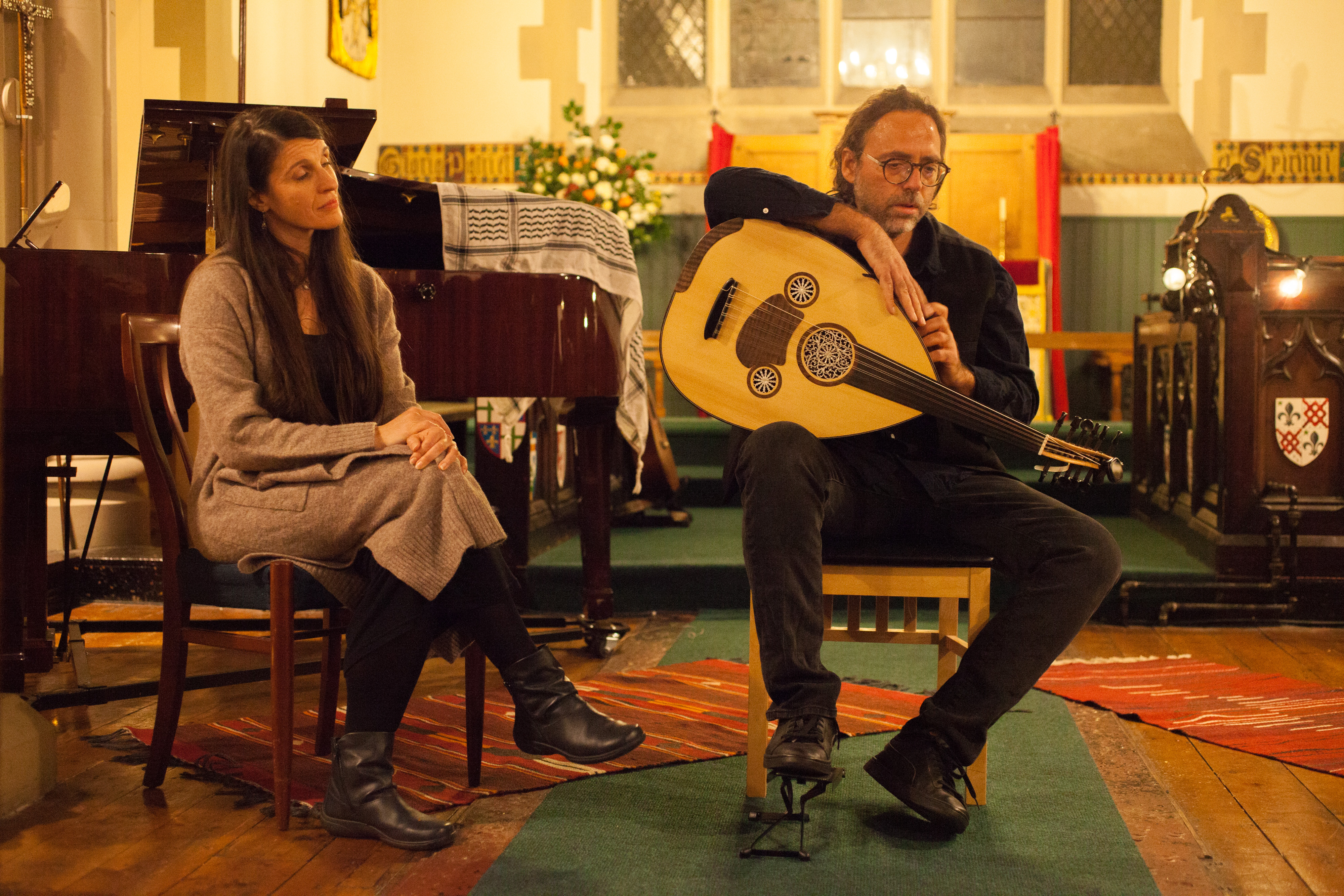
Once, in a small nursery in Italy, I played the oud for a group of children.
They were five years old, of course, laughing, restless, with no idea what this strange pear-shaped instrument was.
After I finished, one of them raised a hand and said, “It sounds ancient.”
That sentence stayed with me for years…
How could a child born in a digital world of synthetic sounds, and from a culture that does not have this instrument, feel that the oud was ancient?
How could they recognise a memory they never lived?
Maybe sound itself remembers…
Maybe certain timbres carry the trace of something older than our minds — a vibration that speaks not to knowledge, but to the soul.
A resonance of memory that precedes understanding.
The French philosopher Henri Bergson once wrote that the past survives in two forms: as bodily habit, and as independent recollection.
When I play, both seem to merge.
The body acts — fingers, breath, pulse — while the memory speaks above, shaping motion, bending time.
Music happens in that tension: the hands repeat, the soul remembers.
Machines also have memory.
They store, recall, and recombine data.
But human memory is not storage — it’s a living process, constantly rewriting itself in the present.
It’s not reproduction, it’s transformation.
To remember, for us, is not to retrieve but to reimagine.
Perhaps that’s why certain sounds move us so deeply: because they carry a memory that doesn’t belong to us, but it passes through us.
We don’t understand them — we resonate with them.
Sound, in this sense, is never neutral.
It carries weight — cultural, emotional, historical.
It reminds us that listening is not a passive act, but a form of participation in something larger:
the ongoing dialogue between the past that lives and the present that transforms.
The oud, for me, became that dialogue.
Music isn't written — it is remembered.
Learning music means embodying a living tradition, not analysing it.
The tradition isn’t in the score but in the gesture — in the breath of the teacher, the inflexion of a note, the silence before the phrase.
When I play now, I realise that I’m not reproducing those sounds — I’m letting them move through me, transformed by my own memory.
Each note I play remembers something different, but what it truly remembers is movement: the way life itself migrates through us.
Memory, like music, is never still.
It reshapes , rewrites, dissolves, and reappears.
The sound that seems ancient to a child is not old. It’s alive.
It carries time the way water carries reflections: always moving, always present, always changing form.
So maybe sound remembers before we do.
And maybe our task as musicians — or simply as human beings — is to listen deeply enough to recognise what the sound already knows.
My first album, “Sketches of Memory”, will be released in Autumn 2026. Click here to join the newsletter
#SoundAndMemory #Embodiment #Oud #MemoryInProcess #creativity #memory #tradition #worldmusic #jazz #syncretism #listening